Guided Tours 2011
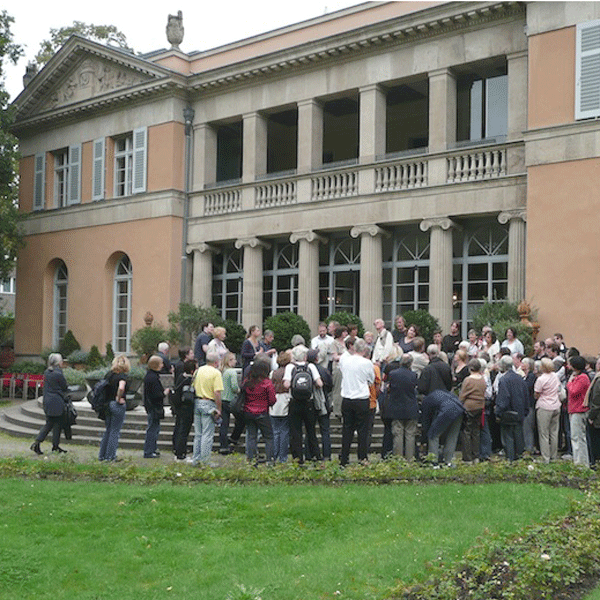
In cooperation with the Erich-Mendelsohn-Stiftung we invite you to the Association’s guided architectural tour showing the interior of Wachsmann-Haus (Haus Dr. Estrich), 1929 by Konrad Wachsmann, in Jüterbog, Bleichhag 6,
Guide: Nils Estrich, architect and grandson of the builder
Saturday, April 2nd, 2011 at 10 a.m.
Meeting point: in front of Haus Dr. Estrich in Jüterbog, Bleichhag 6, before 10 o’clock
Preregistration: until April 1st, 2011 with
Access by train:
RE 5 ab Berlin Hauptbahnhof, Gleis 4, um 8:16, Richtung Falkenberg (Elster)
Berlin Potsdamer Platz 8:18
Berlin Südkreuz 8:22
Berlin Lichterfelde Ost 8:28
Ankunft in Jüterbog um 9:02
Access by car:
Route 1: Von Berlin Autobahn A9/E51 (Richtung München/Leipzig), Ausfahrt 4-Brück, Richtung
Linthe/Treuenbrietzen, in Treuenbrietzen auf B 102 nach Jüterbog
Route 2: Von Berlin (Flughafen Tempelhof) auf B 96 (Richtung Süden), in Alt-Mariendorf auf B 101,
hinter Kloster Zinna B 101 verlassen und den Schildern nach Jüterbog folgen
Invitation to the lecture (in German) at the Erich Mendelsohn Foundation, Landhaus Bejach, Bernhard-Beyer-Str. 12, 14109 Berlin-Steinstücken at 7 p.m. on Saturday, 2 April 2011
Erich Mendelsohn was one of more than 450 Jewish architects in Berlin and around Germany who were
banned from practicing their profession by the National Socialists, as of 1933, further persecuted and later
deported or murdered. These architects were forced to relinquish their membership in the Deutsche
Werkbund, the Federation of German Architects, the Architects and Engineers Association of Berlin (AIV)
and the Berlin Academy of Arts. Their names were often extinguished from memory, their fates forgotten.
But their buildings still stand, lending their distinctive character to Berlin’s urban scene.
In his lecture, Günter Schlusche from the Association for Research on the Lives and Works of Germanspeaking Jewish Architects will present a survey of this group of professionals and their activities, and of the persecution they endured, thereby perpetuating the life’s work of Myra Warhaftig, whose research and publications laid the foundation for the remembrance of these architects. He will devote closer attention to the lives and buildings of the architects Alexander Beer, Ludwig Lesser, Gustav Neustein and Harry Zweigenthal.
Invitation to the Association’s guided architectural tour for the Tag des offenen Denkmals 2011: The Villas Harteneck, Epstein and Konschewski in Berlin-Grunewald
Guide Dr. Günter Schlusche, Claudia Marcy
Saturday, September 10th at 2 p.m
Meeting point: Douglasstr. 7, Berlin-Wilmersdorf
Public transport: S-Bahnhof Grunewald
Contact: guenter.schlusche@web.de
The villa Harteneck, built in 1910-1912 by the Messel-disciple Adolf Wollenberg, as well as the villas Epstein and Konschewski, built around 1920 by the famous architect Oskar Kaufmann, represent a classical but also neobaroque architecture influenced by historical examples. At the same time these buildings of the two important Jewish architects represent the cultural niveau of villa architecture and of landscape gardening in the early 20th century. From 1933 both architects were persecuted by the National Socialists and forced to emigrate.